
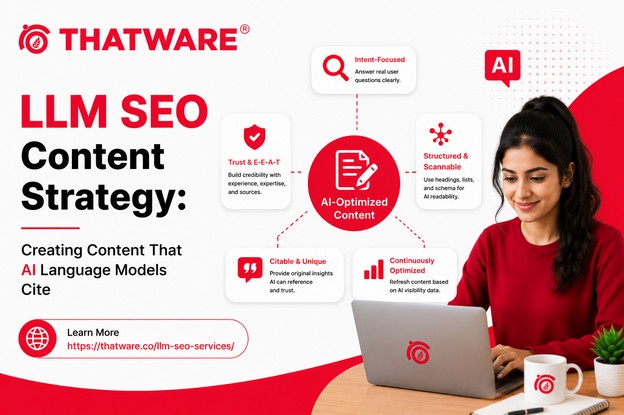
Here’s something that doesn’t get said often enough: most of the content on the internet is genuinely not useful to AI models. It’s thin, repetitive, written for keyword density rather than comprehension, full of claims without evidence, and structured in ways that make it hard to synthesize. AI models are trained on text — they’ve ingested enormous portions of the web — but they’ve also learned, in a sense, to distinguish between content that contains real information and content that’s performing the appearance of information.
The brands that win AI citations are producing the former. The ones that don’t get cited are still producing the latter.
This is a look at how to build a content strategy genuinely designed for LLM visibility — not as a gimmick, but as a fundamental rethink of what content is for.
Starting With What AI Models Need to Know
The wrong way to approach this: “what keywords do I need to rank for?”
The right way: “what does an AI model need to know to confidently recommend my brand in response to a relevant query?”
Those are genuinely different questions, and they lead to different content. Keyword-driven content is written for humans who need a nudge in a specific direction. LLM-optimized content is written to inform a system that synthesizes information across sources and makes probabilistic judgments about who is credible, what a brand does, and when to recommend them.
AI models need to understand: exactly what your product or service does, who it’s for, what problems it solves, how it compares to alternatives, what evidence exists for its effectiveness, who talks about it and what they say, and where it fits in the broader ecosystem of your category. Content that addresses all of those questions — across multiple pieces and multiple distribution channels — builds the kind of rich, consistent signal that makes citation more likely.
The Anatomy of Content That Gets Cited
What does high-citation-potential content actually look like? A few characteristics show up consistently.
Specificity over generality. “We help businesses grow” is uncitable. “We help mid-market B2B SaaS companies reduce customer churn through AI-powered health scoring” is citable. The more specific a claim, the more useful it is to a model synthesizing information about your category.
Claims backed by evidence. Models are trained to be appropriately skeptical. Content that makes assertions and then supports them — with data, case studies, quoted expertise, or documented methodology — is more trustworthy to the model than assertions alone. This doesn’t mean every paragraph needs a citation, but it means not making claims you can’t substantiate somewhere nearby.
Answering actual questions. The best LLM-cited content tends to be formatted around questions — explicitly or implicitly. Not in a rote FAQ way, but in a “this is the question that matters and here’s a real answer” way. Think about the five most important questions someone in your target audience would ask an AI about your space. Then create content that provides the best available answer to each.
Consistent entity information. AI models build representations of entities over time. If your About page describes your company one way, your LinkedIn another, your press release another, and a journalist article another — that inconsistency makes it harder for models to build a confident representation. Consistency across your content ecosystem (without sounding robotic) is an underrated signal.
Content Types With High Citation Potential
Not all content formats are equally useful for LLM visibility. Based on how models tend to draw from different content types:
Original research and data is exceptionally citable. A study your company conducted, a survey of your customer base, proprietary industry data — these create factual anchors that models can reference. “According to [Company]’s 2024 study of 500 CMOs…” is the kind of thing AI systems love to cite.
Detailed comparison content — genuine, honest comparisons of your product with alternatives — tends to appear in AI answers to comparison queries. Not because the model thinks your comparison is unbiased, but because it’s a source that discusses the comparison with specificity.
Expert opinion and thought leadership, when tied to specific named experts with verifiable credentials, carries more weight than anonymous brand content. If your CEO or chief product officer publishes perspectives under their own name, that creates citable authority that anonymous blog posts lack.
Working with a LLM-friendly content optimization agency that understands these distinctions helps ensure your content investments are going to the formats and topics most likely to influence how AI models represent your brand. Not all content is created equal for this purpose, and allocating budget wisely requires knowing the difference.
Distribution: Where Content Lives Matters
A piece of excellent content that lives only on your own website has limited LLM visibility impact. AI models draw from a distributed ecosystem of sources — your site, sure, but also news coverage, industry publications, review sites, community discussions, partner mentions, academic databases, and more.
Your content strategy needs to account for distribution explicitly. Getting your research cited in an industry publication is more valuable for LLM visibility than publishing it exclusively on your own domain. Earning coverage in niche trade outlets your target audience reads builds a different kind of signal than writing for your blog.
This is the “earned media” dimension of LLM SEO content strategy. Owned content builds the information foundation; earned coverage builds the distributed authority that models weight heavily when deciding whether to cite.
AI search optimization for LLMs at the strategy level means thinking about both dimensions simultaneously — what you publish and where it gets picked up — not just treating your website as the primary distribution point.
The Temporal Dimension: Keeping Content Current
Here’s something easy to overlook: LLMs increasingly have access to recent information through retrieval-augmented systems. Content that’s clearly outdated — or that hasn’t been refreshed to reflect how your product or market has evolved — can actually work against you.
This doesn’t mean churning out constant updates for the sake of freshness. It means ensuring that your most important content — the pieces that answer core questions about what you do and who you serve — is reviewed regularly and updated when the information changes. Stale product descriptions, outdated positioning, or case studies from five years ago can muddy your LLM representation even as you invest in new content.
A living content strategy — one that treats content as a maintained asset rather than a production output — is what LLM SEO requires. Build it right the first time, then steward it well.